Showing posts with label India 2007. Show all posts

January 21, 2008

Kashmiri "siking"


"Siking" is skiing in Kashmiri and is, so I guess, more or less the same thing. That is besides the huge amounts of fresh snow, the lack of spaghetti bolognese and tartiflette, the remoteness and size of the mountains, the low number of other "sikingers", the inconsistency of the liftsystem and the number of soldiers and guns around every corner.

January 7, 2008

Village life, wildlife and beach life

Posted by Janine & Mikkel

We had the privilege to begin 2008 on a beautiful beach in Kerala for 5 days of pure relaxation -and some tough decision making. The two weeks before we toured South India visiting palaces, huge temples, a tiny village and a wild life park with a traffic jam.

The journey started with a chilly night train ride and a couple of rainy days, but luckily there were some impressive palaces and temples to visit which didn’t need too much sunshine. After a few days we moved on to one of the highlights of our trip: Dhana, Janine’s ‘local supervisor’ who became our best friend in Chennai, invited us to come and stay in her (parents) village, located between green hills, palmtrees and small rivers. The sister, uncle, grandparents, daughter, cousin plus all their neighbours made us feel like part of the family –even if they didn’t speak English. We didn’t do much besides sitting, chatting, drinking tea, going for walks, being served snacks -and drinking more tea. Women would sit and chat with each other in the small kitchen, while the men would sit in the back and watch tv. We would all sleep together on the floor in the two rooms. Whenever we got served food, they would tear off a fresh leaf of their bananatree: guests are supposed to eat from a banana leaf as a gesture of hospitality. They only have one banana tree so I guess it was good that we only stayed two days.

After a stop-over in Madurai, South India’s beautiful temple city, and a quite uninspiring Christmas in a chilly hill station (a movie on tv and a bad stomach for Janine), we took a long busride to a renown wildlife sanctuary, which is supposed to host 49 tigers. We didn’t get to spot any of these, but we did see some unexpected ‘wild life’: people literally fighting at the ticket office in the park at 6 in the morning, to buy tickets for a boat ride! Because of the Christmas holiday, the park was visited by thousands of Indian tourists, creating a Chennai-like traffic jam of stinking noisy busses and cars at the entrance of the park…This slightly degraded our ‘nature experience’ but the boatride was quite nice, and we took a walk where we spotted some black monkeys and even a snake.

After all this action, and a quite awful encounter with some street children at a bus station who decided not to let go of our arms and legs (we were forced to flee the station) we needed a real holiday. Luckily this had already been planned. At Varkala beach we had arranged to meet up for New years with a nice group of people: a funny Scandinavian mix of two PhD-students, a Swedish teenager who's helplessness brought the best "mothering" out in Janine, and an Indian who’d studied in Denmark. The beach was situated between two cliffs, there were palm trees as far as you could see and the small beaches were equally shared between tourists and fishermen. We had at least three important decisions to make every day: where to eat breakfast, where to eat lunch and where to eat dinner!

Easy life? Well, we actually had to use our brains for more than the menu. First of all, we were challenged by the Indian guy to play the Dutch game Koeienhandel (Cow Trade), which turned out to be a major hit and kept us talking for days in deep sincerity about the deals on cows, pigs and chicken that we had made. Another, more serious challenge was presented to us on newyear’s eve: the Swedish girl found out the hard way that India unfortunately also has creeps who put drugs in your drink. We had to carry the poor lifeless girl home at five in the morning and get her back to this world again - luckily she was fine the next day.

At the moment we are entering the second stage of our trip: we just arrived in Pushkar after surviving a 30hour train ride and two days in Delhi. Our major concern for now is if Mother Nature will donate some serious packs of snow to the Himalaya SOON, so that we can actually make our skiing dream come true next week… while Janine wrote this I (Mikkel) checked the weather reports: 60-70 cm of fresh snow and still going!

Rests us to say happy New Years to all of you!

Lots of love and hopefully see you in three weeks time,
Janine and Mikkel

December 11, 2007

Aerobics!

(posted by Janine)
Sport opens new doors. Last week Mikkel wrote about the marriage we got invited to through some of his badminton mates. As for me, I get some fascinating experiences through my aerobics/taebo class –and I’m not only talking about the funny Indian moves I’m learning. First of all our teacher, or ‘master’, is distracted for about one-third of the time because he’s on the phone or sending sms-es. And half of the times, it becomes a private class since I am the only participant. But when I do have a fellow participant, our Indian taebo moves usually get disturbed by the long discussions between this girl and the ‘master’ about his marriage problems! The master is having a love-marriage (=not arranged) and therefore… a LOT of trouble. He complains about his wife’s demanding behaviour and the girl gives him advice as if it is relationship therapy. You can imagine me standing next to them hinting to continue the class…but it never helps. In the meantime, she secretly explained to me that in a ‘normal marriage’ like hers, people usually don’t have problems like that.

Now the reason that I am often having ‘private class’ is because this other girl (or woman actually) has to stay at home to host some visitors of the family. This family consists of her daughter, her husband, his parents and his grandparents. According to their ‘tradition’, she has to run the whole household. When her father-in-law stands up, it is necessary that she also stands up to show him respect. She explained this to me when I had (a huge) dinner at her place yesterday. All this doesn’t mean that she has no ambitions. In fact, she has graduated in both English literature and sociology and worked for one year as an education consultant. She told me that she very much enjoyed her work but then…she got married. Her new husband didn’t want her to continue working and according to the tradition, you have to obey your husband. So she quit and became a housewife, even long before she had her child.
They live in a tremendously big house with a dog, inside garden-pond, roof terrace and (of course!) two maids: 17-year old girls from a rural village, who almost dropped their plates when I arrived, out of excitement for seeing a foreigner. Her 10-year old daughter has the biggest collection of Barbie’s I have seen in my life –hundreds of them- still packed in their original plastic. Not that the daughter sleeps in her room, because according to the tradition, it would be selfish of parents to keep their children separate. So the child always sleeps in bed with them.

When the parents of my aerobics-partner found her a suitable husband 14 years ago, they were engaged for 5 months and by the time they married, she was actually in love with him. So she is happy with her life and with her marriage. And now she is giving all her best advice to the aerobics-master because she knows what a good marriage is all about…

In the meantime, I might not get the work-out that I wanted and will never get the hang of these Indian moves, but at least I get to hear some interesting relationship-gossips!


For the ones who are curious to know the Tamil version of Brad Pitt (his name is Vijay and he is all over on the billboards):


With Prasad and Didi (Janines classmate from holland) in one of the few Chennai bars:


Typical street sight after a heavy heavy rainfall:

November 30, 2007

”Marriage…it’s a gamble!”

(posted by Mikkel)

Yes, we are still alive and kicking here in Chennai. Since coming back from our holidays in October it’s been all work and no fun…or at least more work and less fun! Janine is busy writing an article for an Indian journal so for the moment we are playing the academic version of a happy family both bend over our laptops. But in between there is time enough for Diwali celebrations (the biggest Hindu festivity of the year), beach trips, social visits, badminton (me), private tae-bo / aerobic class (Janine … when the ‘master’ shows up), nightly rat chases, cooking classes, restaurant visits and this weekend a real Indian “Monsoon Wedding”.

As many of you might know marriage is a whole different affair in this country. The biggest difference: most marriages are still arranged. And I’m not talking about mamma and papa just organizing the venue, the menu and the invitations…no in most cases they also organize your soulmate for life and genetic material for your future offspring. The days where husband and wife had never met each other and had very little or no say in the matter seem to be long gone in middle class India. But the Western style “love-marriages” are still looked upon here with suspicion and doubts from both the parent generation as well as Indians our age. Almost all of the middle aged married people we meet here in Chennai had their marriage arranged by the parents not really knowing their husband/wife until the day of marriage.

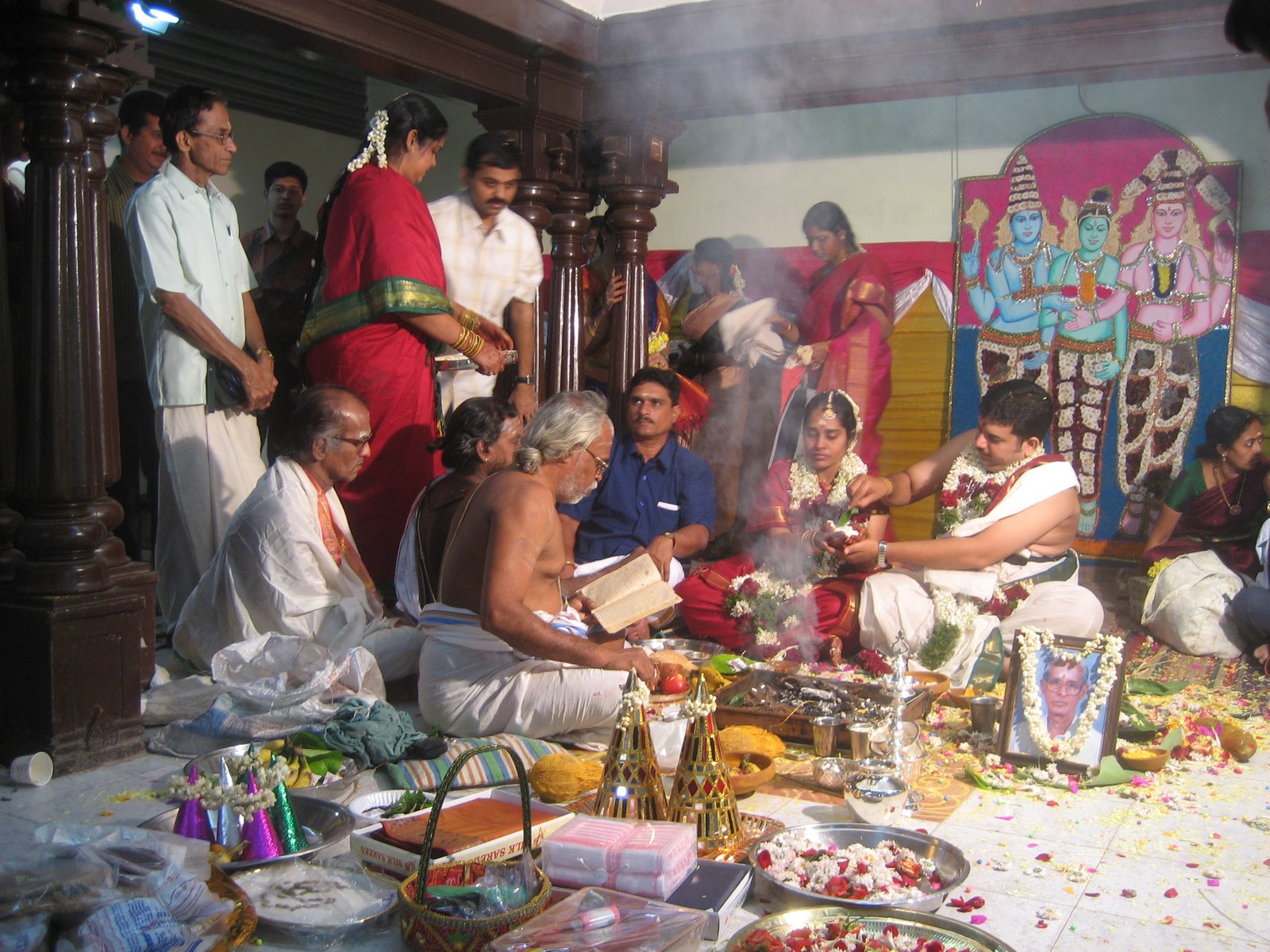
The marriage we went to Sunday and Monday was a South Indian Brahmin wedding (Brahmin is the highest caste). We were told that wedding traditions differ tremendously according to religion, caste, subcast and region. The couple – Nalili and Prakash – that I know from badminton, actually met each other at the badminton court. Prakash figured out that she was from the same caste or subcast as himself and went to ask Nalili’s parents for her hand in marriage. Nalili told me that she had not known anything about his marriage ideas. Although not “at all in love with him” at that time, she thought he was a good person so said yes. “At least this way I knew my husband was a nice guy…otherwise it’s a gamble” she told me with a smile, “and now we love each other.” Some of the guys from badminton said that Prakash had been lucky because Nalili was from the same caste. Otherwise he would not have had the chance to choose himself. “But do you then want a love marriage?” I asked them. No, most seem to agree. Love marriages are dangerous. Too many expectations, complications, etc. and they also don’t want to upset their parents by going against their wishes.

“Love marriages” often fall apart people say. I’m not surprised: young (and old) Indians fall in love like everyone else in this world I guess. When passions run high, they can choose to either keep it secret (can be difficult when you live with your parents) or else marry quickly. Maybe not the best circumstances for taking such an important decision! When the marriage is arranged, rational choice is applied (as well as planetary positions, ancient caste systems and profit-hungry marriage brokers) and expectations are fulfilled if the partner for life is respectful and nice.

In the Indian middle class the arranged marriages seem to continue for at least one generation more. But the marrying men and women try to influence the choice by vetoing the parent’s suggestions or by suggesting someone that they know, who falls within the acceptable caste/religious group. Many families also use marriage brokers and internet (like www.1rupeematrimony.com). It is interesting to compare this with the popularity of internet dating sites at home where people also look for partners within the same professions, with the same interests, or even looks, etc. One big difference is of course that here in India there is no “testing ride” for a couple of years, but just a number of social visits (no touching of course). So in that way it is still a gamble…but a gamble where the odds can be influenced just a little bit improved in one’s favour.

The wedding happened over two days. First day (Sunday) was the reception. 500-600 guests in turn greeting the couple; having a photo taken; moving on to the rows of chairs facing the couple or listening to classical music in the hall next door; in groups moving into the dining hall to be vastly and fastly fed (a 12-15 minutes mouth watering experience) and after that leaving for home. The whole visit lasting between 1-2 hours. Of course a lot of chatting going on, but no party as we know it with dancing, speeches, everyone dining together, drinks, fun, etc. Oh yes, in case any of you ever invite an Indian for your wedding: if nothing else is said, the invitation also goes out to his sisters and brothers, parents, grandparents, children, visiting friends, etc!

Monday morning was the real marriage with several important rituals. Most important one: the groom tying a rope around the bride’s neck while she is sitting on her father’s lap. No need for long explanations of the symbolism I guess! Due to strong beliefs in astrology this must happen at a very certain minute. Two priests are leading the whole thing instructing the by now very tired looking couple and reading aloud from an old handwritten book with Sanskrit scriptures. There is a fire and they make offerings to the gods, get blessings from guests, etc. One of the last rituals involves a ball game where the bride and groom must play with a coconut. I guess this made more sense back “in the olden days” where the bride and groom where children of 14-15 years old who had never met each other before.

Today people marry much later: The woman often in her late 20ties and man in beginning 30ties (the middle classes). But “no sex before marriage” is still considered the norm (Janine will tell more amusing details about this next time). How many actually live up to this? Probably 1/2 - 1/3 of the men. The women are more innocent…or just better guarded and watched!

We have only a little more than two weeks left in Chennai now. But we promise to write soon again this time.

Take care all of you.

Picture to the right: Hindu Divali ('festival of lights')celebration at the house of Janine's translator Krishnaveni


October 31, 2007

A fantastic break

Posted by Mikkel & Janine
After many weeks of hard work (see for instance the pictures from previous posting of which the text unfortunately went missing due to dehydration of our bodies in a very hot and musty internet cafe as well as a nearby beach calling us :-)) we really felt we deserved a holiday. Besides, we had a highly distinguished delegation of 6 Danes to attend to! Two of them, Kenneth and Sarah, were even brave enough to come to Chennai. So we had the honour of showing them all the beautiful sights of our present home town. That is unfortunately done pretty fast so the second day we went to a quiet (and clean) beach just south of Chennai.


After the weekend here with Sarah and Kenneth, we took the night train to Kerala on the west coast where we would meet the rest of the Danish delegation. Kerala, “a stunning region of coconut groves, astonishing rivers, paddy-fields and idyllic palmfringed beaches” according to our companion “the Lonely” [Planet], proved to be a great choice. The 8 man strong delegation now existed of Sarah, Morten, Oskar (their 2-year old son, hereafter referred to as “the baby”), Brian and of course Sarah and Kenneth and the two of us. In our first week we floated along palmtrees while eating delicious masala style tiger prawns on our deluxe houseboat; we rubbed down elephants in a river; saw a traditional (but also rather boring) Indian dance performance, got a traditional rather intimate Indian massage (could have been more boring), got sunburned on ‘secret beaches’ (some more burned than others) and walked through cute villages where cute people always wanted to touch the cute cheeks of ‘our’ cute baby.

The second week started a bit more “off the beaten track” as the Lonely would probably call it. Mikkel had read about the small village where people were crazy about football; quite a rare case in this cricket-focused country. After almost endless questioning about this rare phenomenon of Indian football maniacs we finally found someone who knew the place. It turned out to be a very poor village. They were indeed crazy about the sport, although their only place to play was an old slaughterhouse or the beach. They didn’t really have enough footballs or clothes but they did have 12 clubs and knew (better than Janine) when the dutchies won the world cup! Our visit didn’t stay unnoticed: we were accompanied by a whole crew of reporters including a cameraman, two journalists and a photographer as well as somewhere between 50-100 local people. At the end the tv-crew wanted to finish off with a couple of questions for us in front of a running camera and a crowd of 50 people: “What are you going to do to help this village?” … You should have been there to hear Mikkel’s and Morten's mumbling replies!

We never got to see our 15 minutes of fame, because we were taking the night train to Goa that evening. This train ride in itself turned out to be quite adventurous, since the “5-minute stop” at the station 6 o’clock in the morning suddenly turned out to be a 1 minute stop instead. And you can’t get 5 people, 5 backpacks, a number of smaller rucksacks, a baby trolley and a baby out of a coupe through two narrow train doors in such a short time. Or…can you? (We leave this part up to anyone’s imagination, but we like to give some hints: only one person (and no luggage whatsoever) remained in the train although this was mostly due to the train personnel holding him back, one person learned the hard way how you are not supposed to jump out of a moving train, and the baby got out safe and sound due to the responsible and spectacular moves of a white superman who must have watched too many action movies set aboard running trains!)
After all this hard work of performing on tv and jumping out of trains at 6 in the morning, we opted for the “do-nothing-on-a-beach-for-five-days-plan”. Goan style: sun bathing (the only place in India where you can swim in bikini without Indian male audience), a bit of yoga on a rock, a book, some cocktails, playing in the sand with the baby, seafood, seafood, food… Did we mention it was a wonderful holiday?

We are now back in a rain drenched Chennai. The real rainy season started off this weekend with 24 hours of constant rain leaving 7 people killed from collapsing walls, large areas also in the center of Chennai flooded with up to half a meter of water in the streets and an unknown number of people homeless…and this is maybe just the beginning of a so far normal rainy season! So far our biggest problem has been to get our washing dry…

What a wonderful day!

Posted by Janine
Today, as I walked from the bus stop to our home, my foot suddenly (literally) kicked into something mushy. ‘What the heck?’ I thought. Then I saw the fresh brown drab between my toes, proudly produced by one of the many cows that wander on the roads. Great. At least I was on my way home so I could wash it off quickly, although this also turned out to be a bit of a challenge as the power was cut off once again, so I had to manage in the dark. This was my first day after the 2-week holiday we just returned from. What a day! It started with the realization that I had caught a cold, probably during a chilly tuktuk-ride in the rain, so I felt pretty miserable. This mood was soon worsened by the discovery that my wallet was gone. It must have mysteriously disappeared on the train or bus -or anywhere in between- on our way home yesterday. Perhaps it happened while I was holding someone’s baby in the bus (because I had a seating place and the mother didn’t) and my bag ended up under my seat? But it cannot be – the old cute lady next to me seemed to be carefully defending it by keeping her feet strongly tight around it. That’s the way people help each other here (at least I thought?) Anyway, the fact is that I lost 120 euros, which equals 2/3 months income for some people her. My only hope and consolation now is that it didn’t get stolen but that I lost it instead and that some person has a wonderful day (or week, or month)…

October 25, 2007

Janine @ work, in a school with 1000 pupils and 16 classrooms!

Our home (and a hardworking man)


October 8, 2007

Community involvement tandoori style

(Posted by Mikkel)


Our downstairs neighbour Ashok asked yesterday if I wanted to join him and a friend to see a planting project at the beach nearby our house. Apparently a certain type of palm tree works as a really good tsunami barrier. The Indian government wants to test if this plant actually can grow in the beach sand of the Bay of Bengal.

The majority of property along the beach here to the south of the city is owned by wealthy Indians who bought it as investments the last 5-10 years as the city started growing rapidly. In between these walled empty plots there are a number of poor villages and slum dwellings. After the tsunami the real estate prices close to the beach plummeted. They have apparently risen some again, but with the latest tsunami warning a couple of weeks ago they once again took a dive.

Now these palm trees that the Indian government wants to build as a tsunami barrier happen to have a flower with a very special smell. Among the Indian snake community (male and female alike) it is supposedly on a par with the most expensive ones from Dior, Hugo Boss and Calvin Klein! Cobras in particular are supposed to be crazy about the scents of these flowers, and the palm trees even offer a lot of nicely shaded area for the snakes to linger in, while they soak up there preferred perfumes.

So as you can imagine the villagers actually living here are not too thrilled about the palm trees. The day I went was a sort of inauguration of the whole thing. The project manager was there overseeing the planting (of course done by casual workers). To win over the hearts of the locals the plan was to get people from the local community to participate in the planting. The project manager’s driver was send to a nearby school to get some “locals”. Unfortunately the kids that came back with him tempted by free pepsis and seven ups where too young – there was a fear that the project could be seen as supporting child labour! The teacher that came with the children had a different agenda. She was trying to put pressure on the project manager to lobby for a new building for their school.


Luckily another batch of “locals” was summoned. This time young engineering students. Photos were taken with the students getting their hands dirty in the sand and the community involvement part of the project was considered over! My own hopes for a few minutes of fame were unfortunately killed immediately. A white face, I was told, in the middle of everything could cause confusion about who funded this tsunami project!


kameleon in our garden

September 28, 2007

Daily life in India

(posted by janine)

Here are some small interesting or remarkable things of daily life …

- In all the busses (or in the classrooms, or in the temples) the women/girls sit on one side and the men on the other side.

- A few weeks ago, we got introduced to the Indian movie-scene: we earned 12 euros by ‘playing background foreign tourists’ for a full day in a hotel which was the scene for a new Tamil movie, featuring the local version of Brad Pitt .

- About 70% of the time we buy something here, or have it fixed (trousers, a key, shoes etc), it doesn’t work!

- In the office of a Big Director (e.g. some of the Directors of School Education that I visited to get permission for visiting schools) there are piles and piles of paper on the desk, but no computer. While the IT sector is booming in India, the department of education works with typewriters and written paper…

- Although it is officially forbidden, the caste system is still prevalent over the whole of India in the year 2007. At some schools, the girls from the lowest caste/outcaste (still) have to clean the schools and wash the toilets, and are not supposed to sit with the others to eat… (not at the schools that I visited though – this is what we have seen in a documentary)

- A role of toilet paper costs more than a lunch meal for the both of us (=rice, vegetables, sauces and bread) and the same as a three-hour bus ride.

- As I’m writing this, it’s thundering and raining and…the power cuts once in a while, leaving us in total silence and darkness (we keep forgetting to buy those candles)

- There are many small habits that are hard to know as a non-Indian. When I am visiting an older/’important’ person for my research, I may not sit with one leg over the other, in order to show respect. This is quite difficult when you are used to that and when you have to sit waiting in front of the directors desk for more than an hour!

- Arranged marriage is still common practice here, also in ‘the city’. Young people look strangely upon the idea of a ‘love’ marriage – it is not seen as a good thing! Many parents nowadays find the suitable partner for their son/daughter through the internet. One of the most important characteristics to search for is… caste.

- At one of the schools I visited, there were 1700 students and 27 teachers. Some teachers had up to 110 children in their class! Can you imagine teaching about AIDS, puberty and other sensitive subjects in an overcrowded classroom?

- Getting into town by bus takes half an hour. But once you are ‘in’ there, it may take between one or two hours to get to another spot ‘in town’. When we’re lucky, there is a seat available…(each on our own side of the bus of course)

- Indians are very good at ‘hiding’ things. We thought that alcoholism would not be one of the major problems in society here, since we didn’t ever see anyone holding or drinking a bottle. But it turns out that there are small ‘wine shops’ with bars behind it. And yes, many men go there once the night has fallen! I don’t know about the women though.

- Apparently we have a guard in our little village, who blows on his whistle every three seconds for half an hour each night around 23 o’clock, just to let people know that…he is there!

- The amount of people speaking (good) English has become less and less since India’s Independence 60 years ago. I’m glad I have a translator, and I sometimes even need her to explain their English…

- We are creating employment in our village: one women does our washing and another one cooks for us whenever we ask for it! (yes yes it’s decadent, especially since we DO have a kitchen now; but hey: how could we ever beat those mouthwatering curries and veggies of the Indians?) In other words: there are no legitimate household-related reasons that can distract Mikkel from writing his thesis!

- …but as you may imagine, he still manages to find enough other distractions: his favourite occupation is planning trips and dreaming about ‘curry powder’ in the mountains of the Himalaya and specifically: how to arrange to go skiing there…

September 24, 2007

Shit happens!

Posted by Mikkel

We told you about the almost deserted beach 5 minutes walk from our house. When moving in I had a somewhat idyllic image in my mind about us going for morning and evening swims on a quiet tropical beach. I must admit that this image has been shattered. We now use the beach for running in the morning...only! The locals also use the beach (especially in the morning)…but neither for running nor swimming! (You might have guessed it already, no?)

In the poor communities the sanitary arrangements are not as we are used to from home. Most houses neither have running water nor toilet facilities, so it’s only perfectly logical that the people go to the one and only place nearby where their shit (I said the word!) is actually flushed away…just like we also prefer with ours.

Cannot help thinking about the poor guys who were caught with their pants down on christmas morning 2004 when the tsunami stroke.

September 2, 2007

The Chennai Challenge!


posted by: Mikkel & Janine

Well! Here we are with a new spicy story. Hopefully we can make our messages from the Indian continent just as enjoyable and spicy as the tandoori, tikka masala and korma curries that we get served here. It’s been exactly one week now since we arrived in Chennai (Madras), in the south eastern state Tamil Nadu. Before we left, we had been ‘warned’ that this 7 plus million city is not particularly one of the nicest places to visit on the planet. We are afraid that we actually see the point: besides a few nice temples there is not much else either to see, smell or hear than lots of traffic and people everywhere (working, walking, selling, driving, begging, sleeping). All this produces a hell of a lot of noise and smoke which enters your body and your skin as if it were to stay there forever.

----[Picture which shows our general appreciation of the city after a couple of days]----


BUT there are also some positive sides to the city. First of all people seem very friendly. Wherever we go – the bus, the beach, the restaurants – people like to chat. And here we are not talking about the rickshaw drivers, the beggars and the other sellers who generally take no for an answer. Secondly Chennai has a very long and wide beach and although you can’t really swim or lie in the sun there, it’s still nice to cool off in the sea breeze. Luckily we are here in the “cool” period where the temperature is bearable (but still 30°+) and occasional rain-outbursts wash away the smells of the city. And last but not least: the food is spectacular: Dhosas, tikka masalas, tandooris, rotis, naans, parathas, dals, kormas, koftas, idlis, lassis, etc. … its almost all great!

Now here are some of the challenges that we have been dealing with so far:

1. Finding a place to stay
Never before have we started to discover a city with only one criteria: ‘Where would we want to live?’ This question could be translated into: Where are the oasis in this overwhelming hectic chaos of people and noise? Eventually we had to conclude that there is non! And to make matters worse, housing (rental) prices have been rocketing over the last year here in Chennai (due to the IT and software-boom) up to a level that equals Amsterdam and Copenhagen. Besides that, nobody wants to rent out a place for only three months and even less so when it concerns untrustworthy foreigners… After a week of searching and calling, we slightly adapted the criteria and have decided to stay in a cozy guesthouse in the centre which is both much cheaper than any apartment and also includes furniture!

2. Avoiding a ‘Delhi-belly’
Yes yes: We are very proud to announce that we have survived our first week without a Delhi-belly (also known as an illness that causes uncomfortable toilet-visits).

3. Understanding the Indians
Already on our second day here, Janine had two meetings for her research with people from the Teacher’s Union. The first meeting with one of them started off interestingly: After the most difficult phone conversation ever, we decided to go by at his office to speak to him face-to-face. When we arrived there, we found out that he was just on his way to our hotel… Indians talking English are not necessarily talking the same English as we do! (Luckily the second guy did speak very good English, but he was also ‘National General Secretary’ of the Teacher’s Union with 2,4 million members).
Another thing that we haven’t gotten used to yet, is that shaking ‘no’ with your head doesn’t mean ‘no’ here. In fact, it usually means yes! Imagine a conversation with a rickshaw (three-wheel-taxi) driver:

We: ‘Can u take us to…?’
Him: (shakes no)
We: ‘No?’
Him: yes yes
We: ‘So you can take us to …’
Him (shakes no)
etc.etc.


To round up we just want to say one thing: Despite the ‘disadvantages’ of the city, we definitely feel that Chennai ‘has something’ although we don’t really know what it is (yet). It could have something to do with the honest and friendly smiles of the people. So hopefully the coming months will bring a lot more positive news than chicken tandoori to this India story!


PS. REMEMBER TO SUBSCRIBE (to the right) IF YOU WANT TO RECEIVE A NOTIFICATION WHEN WE POST A NEW MESSAGE...

What are we doing here…

Janine:
I am in Chennai to do my final research for my studies in International Development. This means I have to do fieldwork for 2-3 months after which I will have to write my MA-thesis as well as a report for the organization that funds my stay here (Education International). The topic of my research is ‘AIDS education in the classroom’. Although AIDS is not at all such a big problem here in India as it is in for example South Africa, the epidemic could spread really fast among the 1 billion population if nobody gets informed about it. While the government has made a big plan for schools to teach on HIV/AIDS, it is very unclear what actually happens in the schools and what teachers themselves think about it. The topic is still a taboo! The next couple of months, I will therefore be visiting different schools and interviewing teachers, head-masters and other people that are important for decisions about AIDS education.

Mikkel:
I will isolate myself in this quiet place to finally start trying to begin working towards the end of the last part of finishing the final part of my studies!

We plan to come back to Europe the 29th of January 2008. See you then!